
id: "GTE-BLG-009" title: "Off-Grid Solar Systems & Solar Water Pumping: Modernizing Agriculture and Remote Communities in Nigeria" slug: "post-09-offgrid-solar-water-pumping-agriculture" category: "Off-Grid Solutions & Rural Electrification" category_slug: "off-grid-solutions" profile_area: "Off-Grid Solutions for Rural and Underserved Areas (Page 7)" author: "Engr. Emmanuel Nnamdi, MNSE" date: "2026-04-22" reading_time_minutes: 8 tags: ["Solar Water Pumping", "Off-Grid Solar", "Agriculture", "Rural Electrification", "VFD Inverter", "Irrigation"] featured_image: "images/featured.jpg" meta_description: "Transform commercial agriculture and rural community water supply with off-grid solar water pumping in Nigeria. Discover VFD solar pump inverters, sizing, and zero-fuel irrigation." related_products: ["GTE-SOL-001", "GTE-SOL-009", "GTE-PWR-007", "GTE-PKG-005"] related_services: ["Off-Grid Solar System Engineering", "Solar Borehole & Irrigation Pumping", "Rural Community Mini-Grids"]
Off-Grid Solar Systems & Solar Water Pumping: Modernizing Agriculture and Remote Communities in Nigeria
Introduction: Transforming Nigeria's Agricultural Heartlands with Solar
Across rural and peri-urban Nigeria, agriculture remains the bedrock of livelihoods and national food security. Yet, from commercial poultry farms in Ogun State and fish hatcheries in Delta to vast tomato and maize irrigation plantations in Kaduna and Kano, farmers face a persistent barrier to profitability: Water Access and Pumping Energy Costs.
Traditional reliance on petrol-driven surface pumps or diesel generators to power deep borehole submersible pumps has become economically crippling. With petrol and diesel prices hovering between ₦900 and ₦1,300 per litre, running a generator for 6 hours daily to irrigate a 5-hectare commercial vegetable farm can cost upwards of ₦750,000 monthly in fuel alone.
The solution revolutionizing modern Nigerian agribusiness is Direct Solar-Powered Water Pumping. By eliminating fossil fuel entirely and dispensing with delicate, expensive chemical battery banks, solar pumping systems provide dependable water for irrigation, livestock, and community water schemes with zero recurring operational expenditure.
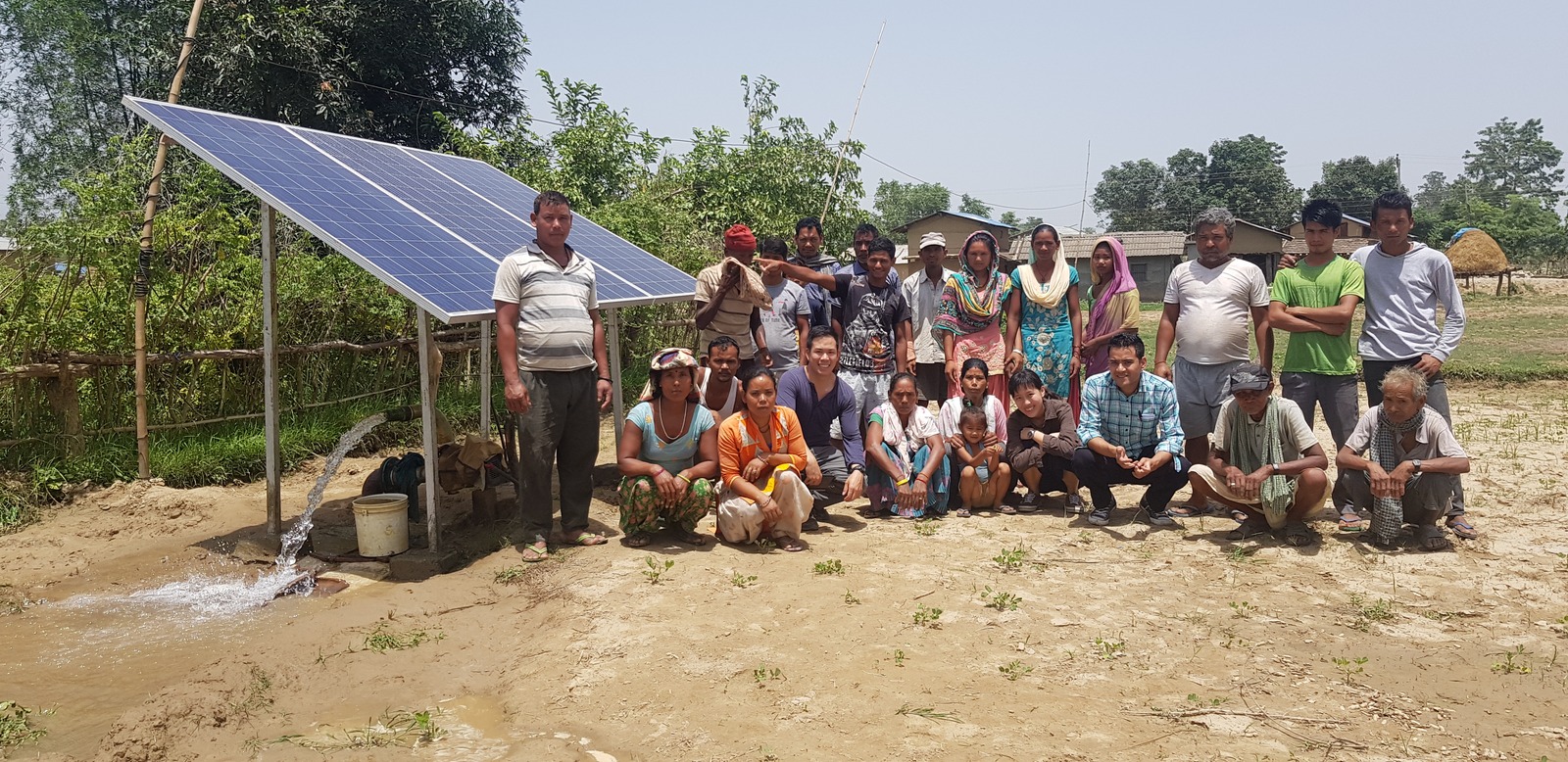
 Figure 1: High-capacity off-grid solar array powering a deep borehole submersible agricultural irrigation pump.
Anatomy of a Direct Solar Water Pumping System
A modern agricultural solar pumping installation engineered by Global Tech Edge does not use batteries. Chemical batteries are the most expensive and maintenance-intensive component of solar systems; in water pumping, water stored in elevated overhead tanks acts as your battery storage!
The Core Subsystems:
- Solar PV Generator Array: High-efficiency Tier-1 monocrystalline panels (
GTE-SOL-005) wired in high-voltage series strings to provide DC power directly from sunlight. - Solar Variable Frequency Drive (VFD) Pump Inverter (
GTE-SOL-009): The brain of the installation. A specialized solar pump controller with embedded MPPT tracking that converts variable DC voltage from the solar panels into variable-frequency 3-phase AC power (230V or 415V). - Submersible / Surface Multistage Pump: Stainless steel deep-well submersible water pump designed to lift water from depths of 50 to 200 meters.
- Water Storage Reservoir / Overhead Tank: Polyethylene or galvanized steel storage tanks elevated on gravity towers to distribute water without requiring auxiliary booster pumps.
- Water Level Sensor Interlocks: Float sensors installed in the borehole and overhead tank prevent dry-running when the water table dips and stop pumping automatically when tanks are full.
 Figure 2: Solar pump VFD inverter controller utilizing maximum power point tracking to adjust motor RPM based on sunlight intensity.
How Solar VFD Inverters Overcome the Motor Starting Challenge
Traditional induction motors draw a massive inrush starting surge (500% to 600% of running current). If you attempt to power a 3HP pump directly from a conventional inverter, you require an enormous, expensive inverter and large battery bank just to handle the instantaneous startup shock.
The VFD Soft-Start Advantage:
A Solar Pump VFD Inverter eliminates this entirely:
- Stepless Soft-Start: When the sun rises, the VFD gradually ramps motor frequency from 0Hz up to 50Hz over 30 seconds. Starting surge is completely reduced to zero.
- Dynamic Speed Modulation: If a cloud passes overhead, the controller does not shut down. It automatically reduces the motor frequency (e.g., from 50Hz to 38Hz), continuing to pump water at a slightly reduced flow rate until full sunlight returns.
- Direct Solar Operation: Delivers up to 8 to 10 hours of continuous automated pumping every sunny day without a single battery cell.
Engineering Sizing Example: 3-Hectare Commercial Drip Irrigation
Consider a commercial farm in Nasarawa State requiring $40,000\text{ Litres (40m}^3\text{)}$ of water daily for drip-irrigated tomatoes and poultry operations:
- Borehole Depth (Static Water Level): 60 meters.
- Pumping Head (Dynamic head + elevation to tank): Total Dynamic Head ($TDH$) = 80 meters.
Step 1: Hydraulic Energy Requirement:
$$E_{\text{Hydraulic}} = \frac{\text{Volume (m}^3\text{)} \times \text{Head (m)} \times 2.725}{1,000} = \frac{40 \times 80 \times 2.725}{1,000} \approx 8.72\text{ kWh daily}$$
Step 2: Pump Motor Power Sizing:
- With an average of 5.5 Peak Sun Hours in Central Nigeria: $$\text{Required Pump Output} = \frac{8.72\text{ kWh}}{5.5\text{ hrs}} \approx 1.58\text{ kW (approx. 2.2HP)}$$
- Selected Pump: 3.0 HP (2.2kW) 3-Phase 380V Submersible Borehole Pump.
Step 3: Solar PV Array Sizing:
- Factoring in motor efficiency ($\eta_{\text{motor}} \approx 75%$) and VFD losses ($\eta_{\text{VFD}} \approx 95%$): $$\text{Required PV Array} = \frac{2.2\text{ kW}}{0.75 \times 0.95} \times 1.25\text{ (Solar Safety Factor)} \approx 3.86\text{ kWp}$$
- Selected Array: 8x 550W Tier-1 Monocrystalline Panels (4,400Wp total).
Economic Payback:
- Initial Turnkey Solar Pumping Investment: ~₦3,800,000.
- Replaced Monthly Generator Fuel & Maintenance: ~₦420,000.
- Payback Period: Under 9 Months!
- From month 10 onward, the farm enjoys 15+ years of 100% free water, dramatically lowering production costs and boosting harvest yields.
Community Water Schemes & Rural Mini-Grids
Beyond agriculture, GTE's off-grid solutions provide vital lifelines for underserved communities across Nigeria:
- Solar Borehole Water Kiosks: Reliable clean drinking water stations for rural villages, public health clinics, and schools.
- Off-Grid Mini-Grids (
GTE-PKG-005/GTE-PKG-008): Complete standalone power stations combining solar PV arrays, lithium storage, and distribution poles, providing 24/7 electricity to off-grid rural communities and telecom towers.
Partner with Global Tech Edge for Off-Grid Power & Pumping
Whether you are establishing a commercial farm, upgrading a rural estate, or commissioning a humanitarian community water project, Global Tech Edge provides precision engineering from borehole surveying to final commissioning.
Our off-grid services include:
- Geological site surveys and borehole yield testing.
- Turnkey Solar Surface & Submersible Pumping systems.
- Agricultural drip irrigation automation.
- Rural community electrification and mini-grids.
Contact our off-grid engineering team today at 08032141557 or email globaltechedge@gmail.com.